

The Government has published its “Accelerating Infrastructure Report and Action Plan” (the Report), proposing a series of actions that aim to accelerate the delivery of critical infrastructure. The Report:
- highlights water, electricity and transport as critical infrastructure
- restates the 12 barriers to infrastructure in Ireland, which were identified by the Accelerating Infrastructure Taskforce (Taskforce) in its July 2025 report on Stakeholder Consultation and Engagement on Infrastructure
- sets out a timeline of thirty actions under four key pillars to assist acceleration of infrastructure delivery
The proposed actions to accelerate infrastructure include legislative reform, simplifying regulatory processes and increasing public acceptance.
If implemented, the practical implications coming from the Report are:
- further legislative and policy reforms are expected to streamline the consenting, procurement and delivery processes
- increased coordination between Government departments to accelerate the consenting, procurement and delivery of infrastructure
- greater involvement by private developers in delivering critical water and electrical infrastructure
- a shift in the risk profile of contracts for procuring infrastructure
- use of new technologies (e.g. AI) to support infrastructure roll out
- increased public engagement for infrastructure projects
The recommendations in the Report are consistent with the Government’s strong focus on delivering infrastructure in Ireland, including the National Development Plan (NDP) and establishing the Accelerating Infrastructure Taskforce (Taskforce). The NDP sets out a total investment of €275.4bn over the period 2026 to 2035, which is the largest ever capital investment plan in the history of the State. The Report affirms the Government’s intent for Irish infrastructure and reaching Ireland’s climate goals.
The Accelerating Infrastructure Report
The Report is based on recommendations from the Taskforce.
Barriers to delivery of infrastructure
The Report identifies three areas that present barriers to delivery of infrastructure:
- the regulatory environment
- the planning and environment legal system
- internal systems
Some of the specific barriers identified by the Report include:
- increased regulatory burden
- an increase in, and consequences of, judicial reviews
- prioritisation and co-ordination of infrastructure and
- uncertainty of funding and project pipeline
Pillars and actions
The Report’s recommendations are structured around four pillars: legal reform, regulatory reform and simplification, coordination and delivery reform and public acceptance.
Pillar 1: Legal reform
The Report proposes a programme of legislative reforms to speed up infrastructure delivery, with the stated aim of reducing litigation and challenges to the consenting process. The Report references bringing forward legislation to clarify rules on the entitlement to bring judicial review proceedings as well as on legal costs, remedies and fast-track pathways for nationally significant projects. It also includes new proposed legislation, which are intended to speed up the planning process:
- Critical Infrastructure Bill: Which would impose a legal obligation for State bodies to fast-track critical infrastructure through the planning, licensing, and other consenting stages. It also aims to incorporate statutory timelines, positive presumptions, and other measures to reduce procedural delays.
- Emergency Powers: Which would provide emergency powers that will allow the Government to speed up specific critical infrastructure in emergencies.
The Report also involves several proposed reforms to judicial review procedure and costs, including the costs recoverable in some judicial review applications. Public consultation on a proposal to introduce a scale of fees to be applied in certain environmental judicial reviews also opened on 3 December 2025 and closes at 5:30pm on 15 January 2026. A link to the consultation is available here.
Pillar 2: Regulatory reform and simplification
The Report notes that Ireland’s regulatory landscape has become overly complex. It aims to examine the practices applied by regulatory bodies and how they communicate with one another and applicants to simplify the process. This will involve applying parallel processes, mandating statutory timelines, and measuring the performance of regulatory bodies.
Key actions include:
- establishment of a Regulatory Simplification Unit
- considering of General Binding Rules to reduce the need for regulation
- an explicit obligation on State agencies to engage with other State agencies and private developers
- implementation of an early warning system regarding EU legislative change on pressing infrastructure
- enabling developer-led utility infrastructure
- establishment of an early warning system learning from precedent case law to improve regulatory processes
Pillar 3: Coordination and delivery reform
This pillar addresses several barriers frequently encountered by Irish infrastructure projects, such as risk aversion, procurement challenges, coordination of approvals and inconsistent planning decisions. To mitigate these issues, the Government intends to implement a number of reforms, including:
- the introduction of risk appetite statements
- reforms to the procurement process
- applying AI and digital tools to support infrastructure rollout
The proposed actions are designed to increase construction sector capacity, drive greater competition, and strengthen value for money, thus creating greater efficiencies from the increased capital investment.
Pillar 4: Public acceptance
The final pillar of the Report is centred around public acceptance which the Report refers to as a ‘foundation of timely delivery’. The actions target public resistance and land access delays and aim to build trust, improve transparency and ultimately accelerate infrastructure delivery. This involves creating a duty for State bodies to cooperate in making land available and accessible for critical projects, enhancing Government communication to promote the importance of infrastructure delivery and establishing a Benefits Realisation Framework for infrastructure projects.
Timeline of proposed milestones
Most actions are targeted for completion in the first two quarters of 2026, which reflects the Government’s ambitious approach to acceleration. The timelines for the proposed milestones are set out below:
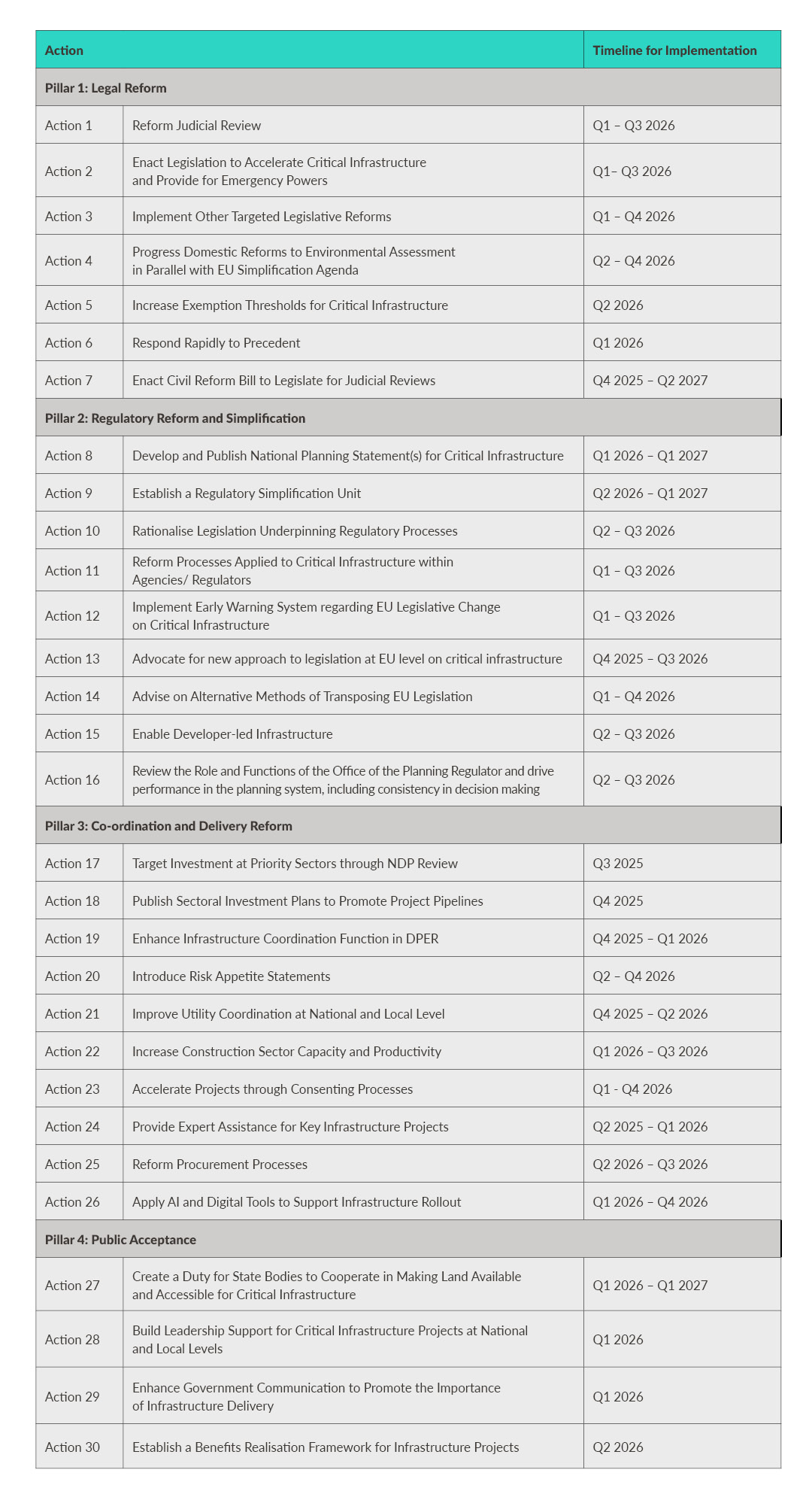
The Taskforce will remain in existence to oversee the implementation of the above actions.
For more information, please contact Ross Moore, John Dallas, Alan Roberts, Alison Fanagan, Lachlan Muir, or a member of either the Energy, Infrastructure & Natural Resources and the Environmental & Planning teams.